Tuesday, December 17, 2013

Is Seed Planting the First Step?


When does the growing season start?  
 In places that have a real winter, it may be when you sit in front of the fire and open that envelope of seed packages.   

Beautiful pictures of bountiful harvests. 

 Maybe you pour some hot cider, get out the graph paper and draw up a plan for where the turnips and beets will grow, and where the tomato plants will get their footing.
To our wheat growers, planting the seed is not the beginning.   
 On his fields in Santa Barbara County, one of our wheat growers, Tom Shepherd, talks about what goes on before seed time.  In his words, seed planting is not the beginning.  It is the end of the first phase.


Good stewards of our lands make it clear that they are not only growing plants.  They are growing the soil.  Improving and nurturing it.  And wheat – both as an edible grain, and as a cover crop for rotation &
soil amendment -- has long been an important part of sustainable farming. 

 Curtis Davenport talks about soil conditions on the land near Santa Ynez where he intends to plant 25 acres of Sonora wheat.
Back on his prepared fields Tom is planting Red Fife, putting 50-pound sacks of seed into the hopper of his seeder … with the help of Max Iniquez, the field foreman.


Our growers know that successful farming is not just about the plants.  Or what shows up above the ground.


Earth asks us to take an oath – an earth oath, which is a phrase you cannot says rapidly six times – and it is just as Hippocrates would have said about caring for the soil:  "First of all, Do No Hurt."

Good stewards of the land are once again growing local grain for local mills and local bakers.  It is not a metaphor but a very real and literal grass roots revolution.

Friday, December 13, 2013

Our Growing Season Begins


The great news is that six farmers have signed on to grow wheat for our Southern California market. 
Their fields are located near Tehachapi, Delano, Santa Ynez, and Lompoc, California.   
Quite different growing areas, with a wide range of weather and soils.  We’ll get to know all our growers in future blogs.   
 Distinct individuals, they have two important things in common: a commitment to sustainable farming practices and a history of growing for local community markets, face-to-face with customers who appreciate knowing the individuals who are growing their food.
It is now official.  Three of our growers have planted wheat, with intentions to grow varieties like Glenn, Sonora, and Red Fife. 
Though it has been quite cold and seed availability has delayed planting by a month, it is exciting that our season has begun. 

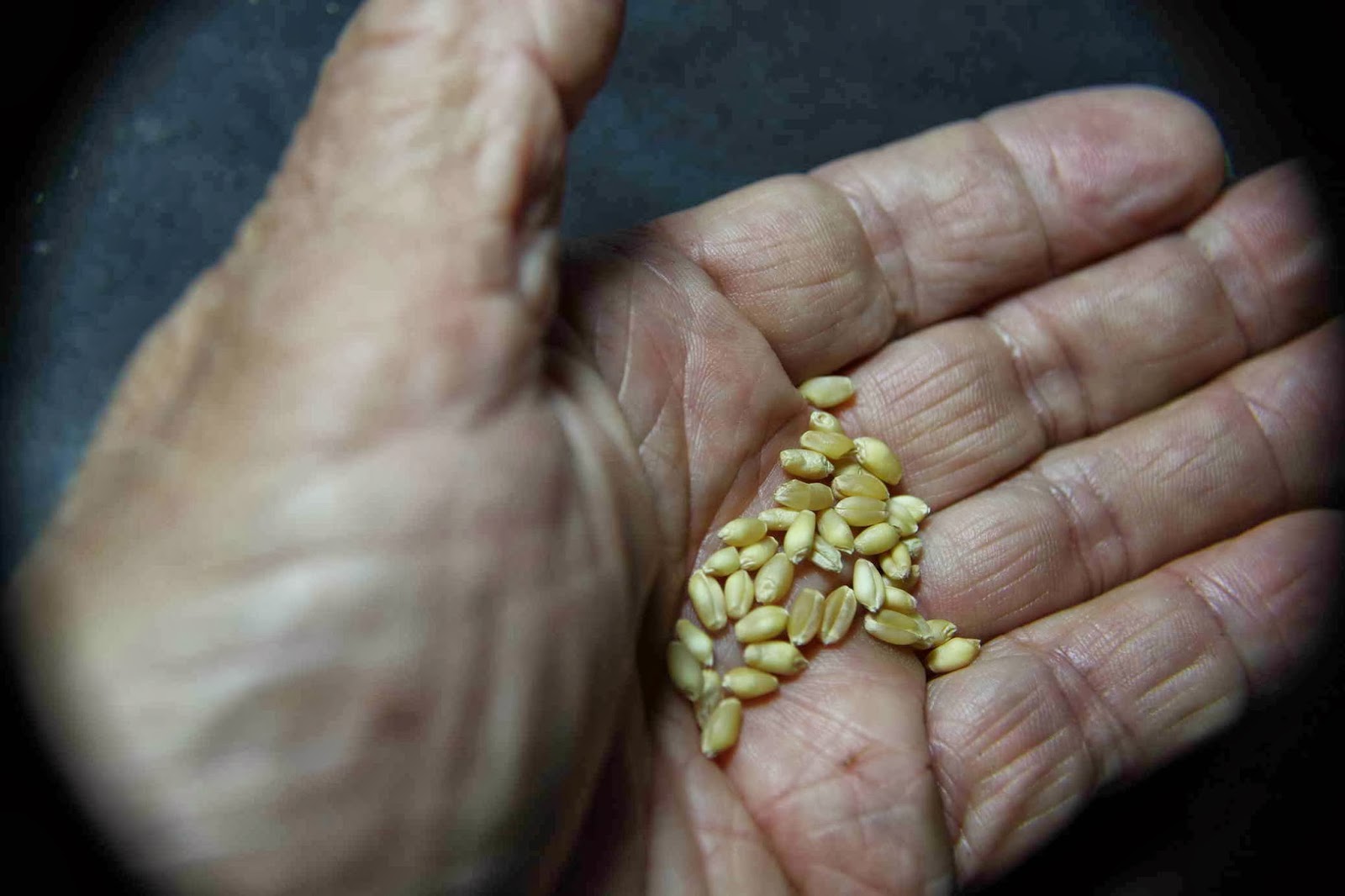
Viability tests show that all our varieties are lively and ready to go, with one hundred percent of tested seeds sprouting in quick time. First, seminal roots emerge in the first 36 hours.
Two days later, the roots, covered with tiny hairs, have extended downward into the soil and the seed has sent its first shoot, called the coleoptile sheath, up toward the surface. 

Planting times for our other growers will be weather and temperature dependent and none of these underground mysteries will be visible.  We’ll just have to wait patiently for those first sprouts to stretch up through that protective sheath, form a crown just below the surface and send the first leaves above the soil, into the air.  Like magic.
Stay tuned.  The season for local wheat, available to local mills, and put in the hands of local bakers – that season has just begun.

Friday, September 6, 2013

Local Wheat


Efforts continue to find quality wheat growers in our Southern California region.
Meanwhile, we can look into cultivating some grain right in our back yards.  Or front yards.  Bake Your Lawn is the motto of a movement that started in the United Kingdom, to grow wheat in the neighborhood and get families and schools involved. 

http://www.sustainweb.org/realbread/bake_your_lawn/


You can do as much or as little as suits you, with the understanding that a couple of rows of wheat along your back fence could yield more than enough wheat kernels for some wonderful bread. 
I planted three 6-foot rows of Glenn in a spot near our garage.  Seed about two inches apart and an inch deep.


The wheat sprouted in three days and was 18" high in three weeks.   
In just over a month, booting took place and seed heads were beginning to appear.


Usually wheat is planted in late fall or early spring, but this crop developed in July and August while we were away and a neighbor was giving them occasional watering.  It happened fast.


Our small acreage had a yield of about one hundred seed heads, some quite open, but most hanging onto their kernels.  

Glenn has a reputation for resisting shattering.
 Looks like about 150g of fresh wheat berries, right out of our front yard.  
Enough to enrich a country loaf of sourdough. 
Send your local wheat success pictures.

Monday, May 27, 2013

Backyard Wheat

Our control crop of Glenn, planted in backyard pots, is finally mature.

A couple of dozen plants were harvested today.  Threshing and winnowing by hand yielded more than ten kernels per seed head, for a total of three teaspoons of very fresh wheat berries.  Our kernels are a little smaller than the original Glenn seed.    Today's reaping is about 20% of our backyard crop.

Having computed the area of the wheat pots to be about one-ten-thousandth of an acre, this represents the equivalent of more than 21 bushels per acre.      It does help to not have hungry ground squirrels.


Final accounting at Maggie's Farm finds our last remaining variety, the spelt, now devoured.

We leave this year's wheat fields in their busy little hands.

Saturday, May 18, 2013

Harvest is Done

The wheat harvest has been completed.  Unfortunately, it is not us humans who did the harvesting.
Only a small area of spelt remains


Essentially all of the wheat is gone. 

 
 Whole plots were flattened earlier and have not recovered.   Areas have been trampelled, and much has been devoured right off the stalks.


The ground squirrels have taken much of the crop.


On May 15th, one of them seemed unaware of a visitor, came quite close and demonstrated how he could reach up, pull a wheat plant down, nibble on the seed head and then move on to the next plant.

Remaining bit of Red Fife
Red Fife seed heads


A small clump of Red Fife remains, but it is more than two weeks from maturity when it can be harvested for wheat.  Unfortunately, it appears the squirrels like wheat berries even before they reach the soft dough stage.  So their harvest timing is significantly in advance of ours. 


Portions of our two spelt plots are still standing, but their seed heads are only at the blossom stage and will certainly be devoured as their kernels just start to develop, well before it is time for human harvest.
        Though Maggie's Farm has not been a successful locale for wheat, it is home to some charming critters
 and some very colorful ones, like this Western Bluebird.

Sunday, May 5, 2013

Slim Pickens

As we approach our expected harvest, it appears we are not the only ones who find wheat an attractive crop.

Our first day's planting of Sonora and Red Fife have been reduced to a small green patch in the middle of the fields.
Glenn planted 11/29/12
The entire plot of Glenn from that first day is gone.  Although matted down some weeks ago, it seemed to be recovering.  However, now it has stopped growing and appears to have been grazed.  One of the traps set against the ground squirrels is in the foreground.
 

Our test plot of heirloom and newer varieties has been grazed to the ground.  Of the 12 varieties planted, 6 did develop well, and, on April 6th, Clear White and India Jammu seed heads were in blossom.  Now all (except two Poole variety plants) seem to have been devoured. 
The northern portion of the 2nd day's planting of Glenn has also been grazed, leaving only an area in the middle of the plot.  The 2nd day's Sonora, on the left, has about half a plot still standing, with seed heads in the late milk stage.   About a third of the Oberkulmer and Maverick Spelt remains and has seed heads emerging.  About a month until maturity.  But our plants seem to be disappearing faster than they can grow.

If we have a harvest, it is likely to be a modest one.