Monday, April 29, 2013

Hoping to share the wheat

The small control group, out in our Los Angeles backyard, is approaching maturity.  A big visual change has taken place over the last few weeks.
In blossom 3/11/13

4/28/13
3/28/13
The control group  -- all Glenn --  exhibits a range of maturity, from soft dough stage to cannot-dent-with-a-thumbnail.  That spread makes it hard to generalize about time to harvest.
                   
Fully ripe
Mixed ripeness
     
Soft Dough
                                         On the subject of hoping to share the wheat .... an intrepid team visited Maggie's Farm on 4/29/13 to set traps in an effort to reduce the threat to our crop from CGSs.  California Ground Squirrels and their habit of stripping wheat fields to the bone.  Ehr, to the straw.

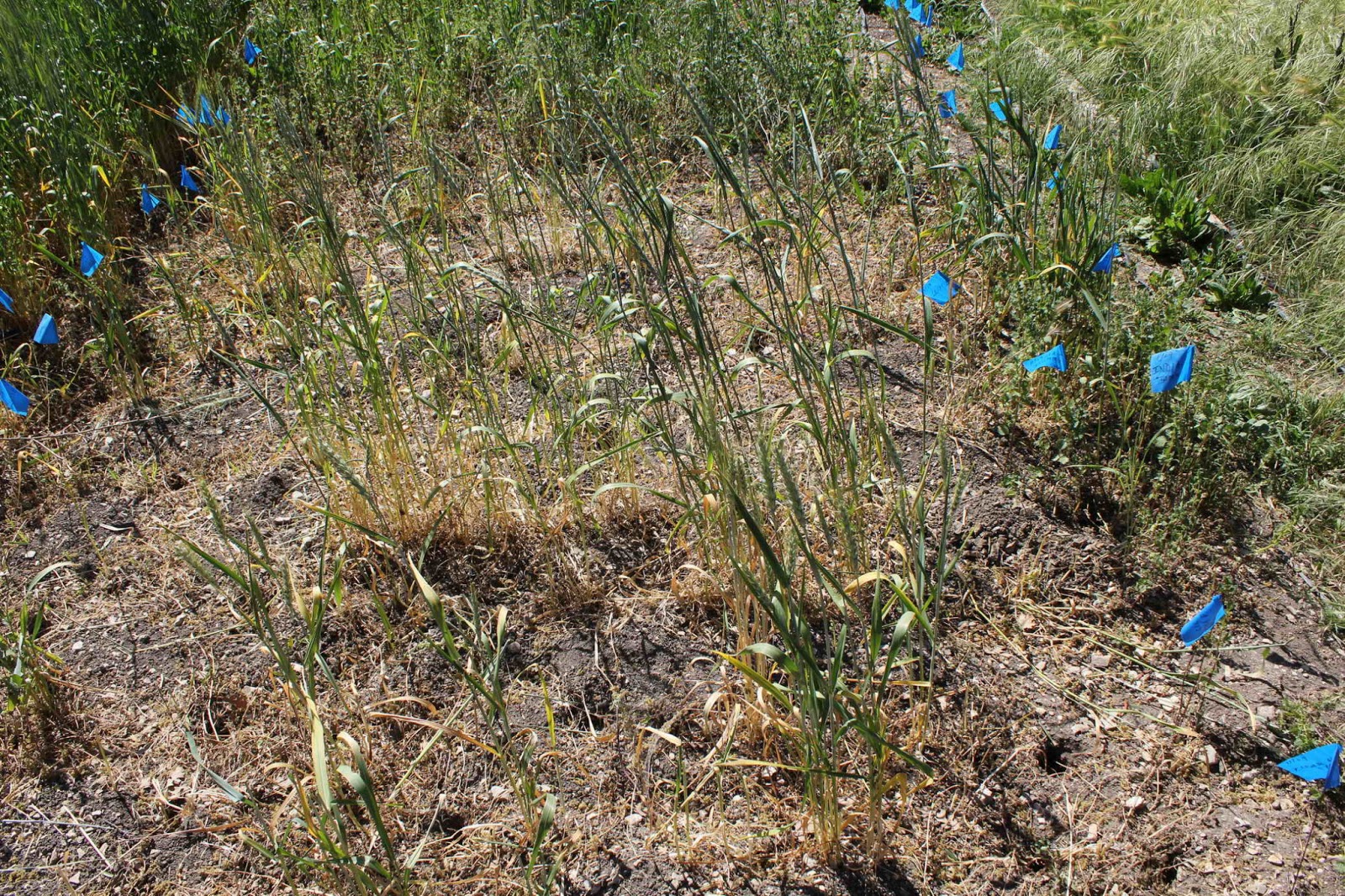
Essentially all of our first plot of Glenn has given up the ghost.  On our last post, it had extensive brown/dead areas in the center.  This has now spread throughout the plot.
                             To the right (west) of that brown Glenn, the Oberkulmer and the Maverick Spelt are doing well.  Both are in boot stage, with seed heads emerging and --if the squirrels don't take it all -- a likely harvest in mid-to-late June.

 Northern portions of our second planting of Glenn and Sonora are doing well, with maturity less than a month away.
Glenn2 on the left, and Sonora 2 on right.

Glenn 2 vigorous, with some trampling.
 

Sunday, April 21, 2013

3rd Week of April

The seed heads are filling, but in many areas plants have not recovered or are very small.  True of all the plots we planted on our first day which had major portions laid flat.

Mostly barren portions of Glenn 1
Northern (near) half of Glenn 2 is quite lush.
Sonora 2 is best overall plot. 


The first Sonora planting, on the left, has much smaller & less substantial seed heads than the Sonora 2, on the right, planted two weeks later.


No sign anywhere that seed heads are losing their green color.  First harvest is still three weeks away, not earlier than May 11th.


Test plot is reduced to a few spindly plants.  Seems under-dug by squirrels.  Very dry.  Very picked over.


 Both of our Spelt are bushy and seem to be in stem elongation mode.  Oberkkulmer taller; much more developed inflorescence and much further along; maybe 3 inches from end of a 15” pseudo-stem.  One of our ground squirrels is keeping a look-out on a distant sprinkler head.
Our two Spelt plots


 If you look close, you can see eight of the rascals in the berm just west of the spelt.


Saturday, April 13, 2013

Reporting Sheepishly

Some of our wheat was reclining because a small gang of young sheep got loose and meandered into the field to have a look.  Not a lot of damage.

 Much of our Red Fife is in boot stage, with some heads emerging.  This puts them about two weeks behind the Glenn.
Red Fife seed head peeking through
Our Oberkulmer (classic) Spelt is now ahead of its more modern Maverick.  Twenty inches, to Maverick's twelve.  Both show inflorescence rising well, about three-quarters of the way to boot stage.  Shorter than the wheat, the spelt is likely to head out in a couple of weeks, blossom, and then start filling.  May have a harvest by June first.
Oberkulmer & Maverick Spelt Fields
The several areas where our first Sonora planting has come back are doing well.  The tall plants have big seed heads.  The shorter plants that had been knocked down are smaller and will probably have a lower yield.  Our second Sonora planting looks very vigorous and its harvest may be mid May, or before.
First Sonora
Closer
Closer Still


 The pig is very friendly and we haven't seen him in the wheat.

Hope to get a sense of how mature the Glenn is when we post next week. 

Friday, April 5, 2013

Life in the Wheat Fields

Progress continues, as the seed heads of more of our crops appear.  In our test plot, India-Jammu and Clear White are both blossoming.


Our classic Red Fife has one or two emerged heads.  Most show prominent inflorescence only about one inch short of emergence.  They will probably emerge and be in blossom before the end of April.

Red Fife Inflorescence Nearing Emergence
The big news is that we see that a good number of California Ground Squirrels are establishing burrows among the wheat.  Spermophilus beecheyi are here.


One of the residents -- we're calling him "Sourdough" -- showed up for a cameo.


The sad fact is that these rascals have a reputation for devouring and hiding away very large quantities of ripe wheat berries

Friday, March 29, 2013

How Goes the Wheat on March 27th?

Good News.  Portions of the first GLENN planting are blossoming.

  More precisely, this is called anthesis, a noun of action based on the Greek word for flower (anthos).  What it means is that the buds are opening as flowers, going through the fun of getting self-pollinated, and starting to become the fruit – those wheat berries we’ve been waiting for.    On average, we would expect these seed heads to be fully mature in five weeks, changing from green to golden tan, and becoming crunchy.  It can happen sooner if the weather turns hot. 


 Our GLENN plot does have a wide range of likely maturity, which means we may be harvesting over a couple of week’s time.  Or more.  As various portions of the field reach maturity, we’ll only be able to give a day’s notice before a few willing hands will be needed to cut and bag the grain from that part of the wheat that is fully ripe.


We’ve also have impressive progress in our test bed. 

Northern half of Test Plot

India-Jammu is the tallest, at more than 31”, with many emerging seed heads.   Clear White is about 24” and has the most seed heads fully emerged.   It is a short-stature hard white spring common wheat with an early season heading time and good resistance to shattering and lodging.   Clear White was developed at UC Davis and released in 2005.  

India-Jammu
Clear White
Louise
Louise, a soft white spring wheat, is also showing promise, with very feathery-looking seed heads.

The spelt has suffered a bit of a set-back, with substantial areas of our Maverick plot flattened.  (It is not certain why.) 


 The portions that remain standing seem to be doing well, but they are likely to be maturing in late May or early June. 


The second planting of Sonora continues to recover from its partial collapse in February.  It still looks as though it will be our second crop to harvest ... after our two plots of Glenn.