Wednesday, January 1, 2014

Goals of Regional Wheat Growing


The goals of the Southern California Wheat Enterprise are not hard to summarize.  Like most such endeavors, the vision is to improve the grains and flour available to our homes and neighborhoods.  And that added value is in three important areas:
Grown in our region    under sustainable farming practices  …. free of chemicals & contaminants   … available direct from growers to mills & bakers
 Flour that is freshly milled … nutritious … good flavored … good for baking
 Provide specific varieties of modern, heirloom, landrace, and ancient grains from specific farms and farmers.

This literal grass roots revolution is really pretty simple.  We don’t have to settle for less than what these remarkable grains have to offer.  Improving the quality of grain and flour is a return to ways that were common not that long ago.  The enterprise believes that our families and neighbors, our bakers and chefs, all can once again have a range of nutritional wheat and flour products that are grown, milled, baked, and then enjoyed by members of our communities.

Tuesday, December 31, 2013

Farm to Table -- Grower Meets Consumer

Those who are growing wheat for the Southern California region, speak with pleasure of selling at farmer’s markets. 


It can be hard work and long days, but they have good things to say about the experience. 


Our Tehachapi-area grower, Jon Hammond, writes: 


 My family bought an orchard and created a small subsistence farm in the Tehachapi Mountains in 1921, growing vegetables and fruits and selling eggs, chickens, sheep and pigs to people in the area and I was raised there -- and bought my first car with money I raised selling pickling cucumbers and pumpkins.”


In northern Kern County, Nate Siemens hopes to grow both modern and landrace wheat, following in the grain-growing footsteps of several generations.  He talks about what it means to provide fresh produce directly to those who will prepare and eat it.


The farmers tell us, when you grow quality food and deliver directly to the customers, it is no longer the food industry or the produce business, it is more like the society of food … the family of food. 
Tom Shepherd, growing Red Fife and Glenn in the Santa Ynez valley, tells what it means to build trust.


The exciting fact is that high quality wheat is being grown in our region as it was many years ago.  


And our families and our bakers will be able once again to enjoy fresh flour with the nutrition, flavor, and baking quality that can only come from wheat that is locally grown, locally milled, and locally baked. 


Everyone in LABB – and every bread baker in our region – can help spread the word that real wheat can once again be available in our communities – and this will include ancient and heritage grains – all sustainably grown on local farms and stone-ground fresh by neighborhood mills.

 Get to know your grower, the person who has planted, cared for, harvested crops and brought them to town for you.  Talk to her or him.  This is not the middleman, the go-between, the intermediary.   No, you are talking to the real deal.   

Weiser Family Farm Stand
Alex Weiser


You can learn a lot, hear about the trials and surprises of farming, see pictures of his kids.  And his goats.     


And finally – and maybe most important – you’ll enjoy a special level of trust. 

Tuesday, December 17, 2013

Is Seed Planting the First Step?


When does the growing season start?  
 In places that have a real winter, it may be when you sit in front of the fire and open that envelope of seed packages.   

Beautiful pictures of bountiful harvests. 

 Maybe you pour some hot cider, get out the graph paper and draw up a plan for where the turnips and beets will grow, and where the tomato plants will get their footing.
To our wheat growers, planting the seed is not the beginning.   
 On his fields in Santa Barbara County, one of our wheat growers, Tom Shepherd, talks about what goes on before seed time.  In his words, seed planting is not the beginning.  It is the end of the first phase.


Good stewards of our lands make it clear that they are not only growing plants.  They are growing the soil.  Improving and nurturing it.  And wheat – both as an edible grain, and as a cover crop for rotation &
soil amendment -- has long been an important part of sustainable farming. 

 Curtis Davenport talks about soil conditions on the land near Santa Ynez where he intends to plant 25 acres of Sonora wheat.
Back on his prepared fields Tom is planting Red Fife, putting 50-pound sacks of seed into the hopper of his seeder … with the help of Max Iniquez, the field foreman.


Our growers know that successful farming is not just about the plants.  Or what shows up above the ground.


Earth asks us to take an oath – an earth oath, which is a phrase you cannot says rapidly six times – and it is just as Hippocrates would have said about caring for the soil:  "First of all, Do No Hurt."

Good stewards of the land are once again growing local grain for local mills and local bakers.  It is not a metaphor but a very real and literal grass roots revolution.

Friday, December 13, 2013

Our Growing Season Begins


The great news is that six farmers have signed on to grow wheat for our Southern California market. 
Their fields are located near Tehachapi, Delano, Santa Ynez, and Lompoc, California.   
Quite different growing areas, with a wide range of weather and soils.  We’ll get to know all our growers in future blogs.   
 Distinct individuals, they have two important things in common: a commitment to sustainable farming practices and a history of growing for local community markets, face-to-face with customers who appreciate knowing the individuals who are growing their food.
It is now official.  Three of our growers have planted wheat, with intentions to grow varieties like Glenn, Sonora, and Red Fife. 
Though it has been quite cold and seed availability has delayed planting by a month, it is exciting that our season has begun. 

Viability tests show that all our varieties are lively and ready to go, with one hundred percent of tested seeds sprouting in quick time. First, seminal roots emerge in the first 36 hours.
Two days later, the roots, covered with tiny hairs, have extended downward into the soil and the seed has sent its first shoot, called the coleoptile sheath, up toward the surface. 

Planting times for our other growers will be weather and temperature dependent and none of these underground mysteries will be visible.  We’ll just have to wait patiently for those first sprouts to stretch up through that protective sheath, form a crown just below the surface and send the first leaves above the soil, into the air.  Like magic.
Stay tuned.  The season for local wheat, available to local mills, and put in the hands of local bakers – that season has just begun.

Friday, September 6, 2013

Local Wheat


Efforts continue to find quality wheat growers in our Southern California region.
Meanwhile, we can look into cultivating some grain right in our back yards.  Or front yards.  Bake Your Lawn is the motto of a movement that started in the United Kingdom, to grow wheat in the neighborhood and get families and schools involved. 

http://www.sustainweb.org/realbread/bake_your_lawn/


You can do as much or as little as suits you, with the understanding that a couple of rows of wheat along your back fence could yield more than enough wheat kernels for some wonderful bread. 
I planted three 6-foot rows of Glenn in a spot near our garage.  Seed about two inches apart and an inch deep.


The wheat sprouted in three days and was 18" high in three weeks.   
In just over a month, booting took place and seed heads were beginning to appear.


Usually wheat is planted in late fall or early spring, but this crop developed in July and August while we were away and a neighbor was giving them occasional watering.  It happened fast.


Our small acreage had a yield of about one hundred seed heads, some quite open, but most hanging onto their kernels.  

Glenn has a reputation for resisting shattering.
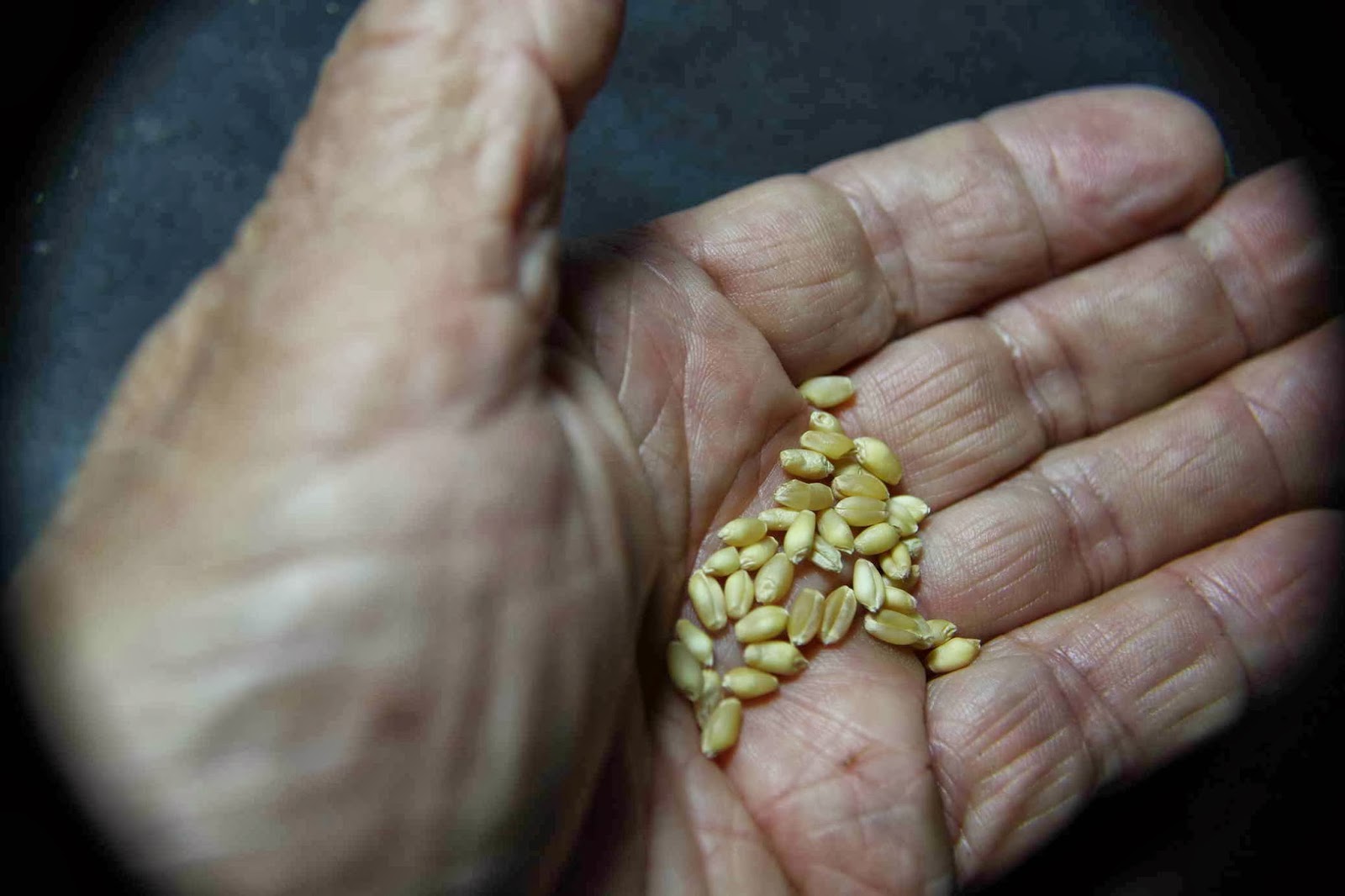
 Looks like about 150g of fresh wheat berries, right out of our front yard.  
Enough to enrich a country loaf of sourdough. 
Send your local wheat success pictures.