Tuesday, March 12, 2013

GLENN Is Leading the Way

March 9th update on Wheat Growing at Maggie's Farm

Some of the fallen wheat seems to be lifting.

Oberkulmer Spelt & Maverick Spelt
Both kinds of Spelt, traditional Oberkulmer and new Maverick, are well established and are beginning to gain some height.


Our test bed is doing well, especially the newer cultivars.


The big news is that our planting of GLENN wheat looks as though it will be the first to harvest.  A sampling of that first planting, now growing for almost 100 days, shows a height of more than two feet, with six leaves fully developed.

Awns showing through flag leaf collar


And that sixth leaf is the important Flag leaf, confirmed by the appearance of seed head awns (or beards) protruding from its collar.


Seed Head Swelling in Stem
This means that the inflorescence has climbed all the way up from the plant’s crown to the top of the pseudo-stem, and is now ready to emerge as a recognizable seed head.  On some of the plants, the young seed head can be seen swelling outward from within the stem, eager to be officially born.


Close Up of Seed Head Swelling
 This is the conclusion of the growth phase called jointing, or stem elongation.  And it is the beginning of the boot phase, after which the head emerges, blossoms, and ripens for the harvest.

Seed Head just Emerging from Stem


Stay tuned.  Four to six weeks until harvest.  Glenn is likely to be the first.

Friday, March 8, 2013

Reclining Wheat

Might it be Sayonara, Sonora?

The first seeds we broadcast on November 29th  were Sonora, a soft white winter wheat, provided by Anson Mills of South Carolina. 

11/29/12
12/11/12


 The emerging plants, along with the plots of Red Fife and Glenn, seemed to prosper, right up through January 22nd.
  

1/22/13
1/22/13


On that day, most plants were more than a foot in height, had 3 full leaves and showed more than half of the 4th leaf emerging.


Three weeks later, large swaths of the Sonora had collapsed.


The condition seemed to get worse over the next two weeks.
2/17/13
2/26/13


with some portions of the Red Fife also lying down on the job.


Red Fife 2/17/13
We may never be able to positively determine the cause.    Damage from harsh weather was one thought, but didn’t account for the way the Sonora was singled out.  Frolicking or restless deer had a vote or two.


Lodging was considered, but that kind of bowing down usually takes places when seed heads are well developed.

 And of course crop circles would have been a candidate, but there were no discernible patterns.  Low moisture levels, exacerbated by dense and shallow planting has come out as a possibility.  Or perhaps the early February nights were too cold for Sonora?

There is hope that some of the downed wheat will recover.  So far, our plantings of Spelt do not have this problem, and much of the Glenn is standing up.   Several rows of newer cultivars in our test plot seem to be doing well.


Sonora 2nd Planting
Unfortunately, our second planting of Sonora has areas that are leaning over.   On a positive note, though, this plot was planted two weeks after the first Sonora.  The inflorescence or embryonic seed head is just beginning its upward journey, starting at ground level, near the crown.

Sonora 2nd Planting Inflorescence Just Starting


 This jointing phase -- also known as stem elongation -- is when the plants gain most of their height.  Perhaps this phase will increase the likelihood that Sonora #2 will stand up straight, and deliver the goods.
  We’ll just have to wait and see what we can make of it all, as we maneuver this steep learning curve.

As my grandfather would say when visitors went overboard in describing their problems:  "Aye, but worse things happen at sea."

Friday, March 1, 2013

We're Getting Close

Seed Heads in Sight

When this season’s wheat growing in Agoura Hills began, on the next to last day of November, I scavenged a handful of seed, from a bit that was spilled on the ground, and planted it in two pots in the backyard of our Los Angeles home. 


12/26/12
1/20/13
It sprouted bountifully and seemed happy with the warm South Bay conditions.
Growing a bit faster than our wheat in Agoura Hills, it has become a control group to watch and measure.

2/26/13
2/27/13


At the end of February, the first seed heads emerged from the FLAG leaf.  Actual kernels are visible.  Quite thrilling, with many of the plants swelling, indicating that more heads are about to come out. 


Back when I pocketed the spilled seed, I was not sure whether it was Sonora, Red Fife, or Glenn, the three varieties planted on November 29th.  Now that the heads are coming into view we can identify them as Glenn because of the beautiful, long, and abundant awns – or beards – up above the emerging heads.  (Sonora has no awns and Red Fife has only two or three short ones.) 

So our control group, covering a formidable one-ten-thousandth of an acre, is showing its stuff and, depending on how warm it is, could have ripe kernels of delicious wheat in 3 or 4 weeks.

The question is: when will the Glenn Wheat planted in Agoura Hills be ready?  Checking a couple of those plants, the inflorescence – or developing seed head – is well advanced up the pseudo stem, with only about an inch more to go. 


Developing seed head within Glenn Wheat pseudo-stem
     

In two or three weeks they are likely to begin showing their seed heads, and the kernels could mature in a month.  


Glenn Wheat Plot     2/26/2013
Yay, Glenn.

Monday, February 18, 2013

The next phase: Stem Elongation, or Jointing         

Our wheat has been growing for three months.  More or less.  It germinated in those December rains, and demonstrated prominent leaf growth, with our Sonora showing three leaves in the first month and two or three more since then.


In fact, leaf-making (and the more hidden root development) is about all that seems to have been happening.


So far, essentially all of the plants’ height is created by the leaves, whose sheaths roll and curve around each other in a telescoping tube, forming a hollow column called a pseudo-stem.  (Not to be confused, I guess, with the real thing.)


Though made up of thin, leaf-like material, the pseudo-stem’s strength and erect stature is like a sheet of typing paper which has little stability if set on edge, but can be quite sturdy when rolled into a tight tube.         
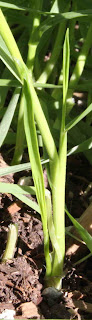

The main plant itself has been holding back, waiting until it knew those leave and roots would be able to sustain it.  Then we were expecting that the wheat plant would launch into its third major growth stage:  Jointing.


My impression was that this jointing or stem elongation was reasonably straight-forward.  The plant gains height as the space between the leaves lengthens.  Maybe more leaves appear.


  Simply stated, the wheat would get taller. And we could look on, as we do with our kids, marking their increasing stature on the kitchen doorway woodwork.


 But a lot more of the process was taking place out of the public view.  During jointing, the embryonic seed head would make its way upward, within the hollow pseudo-stem, heading from ground level up toward eventual emergence into the fresh California air where we hope it will ripen into harvestable grain. 


 And a blog from a soy bean and wheat specialist at the University of Wisconsin opened up a whole new vision.  He made it look simple to slice the plant stem and reveal the tiny hidden seed head that is one of the hidden marvels of wheat.  It's called the Inflorescence, and he described it as a dark green pine-cone shape, with tiny beads, suggestive of the spikelets that would bear potential wheat kernels.


So the exacto knife came out and I began serious surgery on the 1/16th inch wide stems of two month old plants from Maggie’s Farm.  But the results were disappointing, a lot like my first middle school science class when Mrs. Lewisham kept insisting that the microscopic view of the Petri dish was more than a gray blur.


Those first cuts were all near the crown at the base of the plant, right at the soil level since I thought the jointing process had yet to begin.  Success finally came when I made my slice higher up on the plant.  Bingo."


This intricate shape which is making its way up the stem is called the Inflorescence.  The flowering of a plant, often a process going from simple elements to quite complex blossoms that lead to fruiting.


And so this is the big news:  our wheat is well on its way, with that microscopic wanne-be seed head as much as halfway up the pseudo-stem, past leaves one and two, and sometimes past three.

Extreme close up of the elements comprising a wheat inflorescence.
The longest of these little rascals, head-to-tail, is one-quarter inch.

It’s on the march, the leaves and roots supporting its advance through all the leaf sheathes, until it emerges from the final, or Flag leaf.  And, unlike all the other leaves, each of which housed another emerging leaf, that Flag leaf has only one thing up its sleeve – a miniature seed head. 

And that seed head will finally emerge into the air, swell a bit, break into flower, each grain being pollinated in a dalliance with nearby anthers, and be on its way – in about a fortnight – to maturity as a full fledged head of tasty kernels.


Saturday, February 16, 2013

Mid-February Wheat Update

February 13, 2013 visit to Maggie's Farm
       Our initial plantings of Sonora, Red Fife, and Glenn have now had 76 days to grow and are into their fourth leaf.  The Glenn and Red Fife are about 18” tall and seem to be into the stem elongation, or ‘jointing’ phase. 


The soft white Sonora is taller, has a surprising number of tillers, but seems to be only starting the jointing phase.


 The second planting session, 13 days after the first, is also doing well, with the more recently developed Maverick Spelt continuing to do better than the traditional Oberkulmer. 
They are both filling in some of their gaps, and are about a foot tall.  The next-door, 2nd planting of Sonora is at 18” or 20”, and the 2nd plot of Glenn, which was planted a bit deeper, is not quite that tall, but does have more leaf development and seems quite vigorous.


 Our little test plot has some successes, though the intruding nettles are competing aggressively. 


 The four northernmost rows, ML EM118-Z-G, Clear White, India-Jammu, and Louise are almost a foot and a half tall, with Louise the current leader by a couple of inches. 


All are modern cultivars released since 2005. 


The southern portion of the test plot, where many of the older varieties were being grown, is not doing as well.  Even the nettles seem to have given up, so that may not be as promising an area to grow grain.


Biggest surprises of our visit – saved for last – were the large areas of our first planting that were matted down. 


Knowledgeable wheat growers are looking at the pictures and speculating on the likely cause.


 Readers of this blog are invited to comment with guesses, whether it’s heavy weather, wildlife intrusions, crop circles, or something else.  We’ll get some pictures in a few days and see whether they’ve lifted themselves up.

Monday, February 4, 2013

Videos of February 2, 2013 AB1616 meeting


Video recordings of LABB’s February 2 encore meeting on AB1616 Cottage Food Operations are available on YouTube.

Photos & updates by Paul Morgan of 1st two months growing wheat in Agoura Hills:

Remarks by Nan Kohler on artisanal grain mill & Mark Stambler on the background of AB1616:   http://youtu.be/AdLNaHPeYmk   (40 mins)
 
Q&A with representatives of L.A. County Environmental Health:
   http://youtu.be/EzmUUEKHzrw       (45 mins.)